

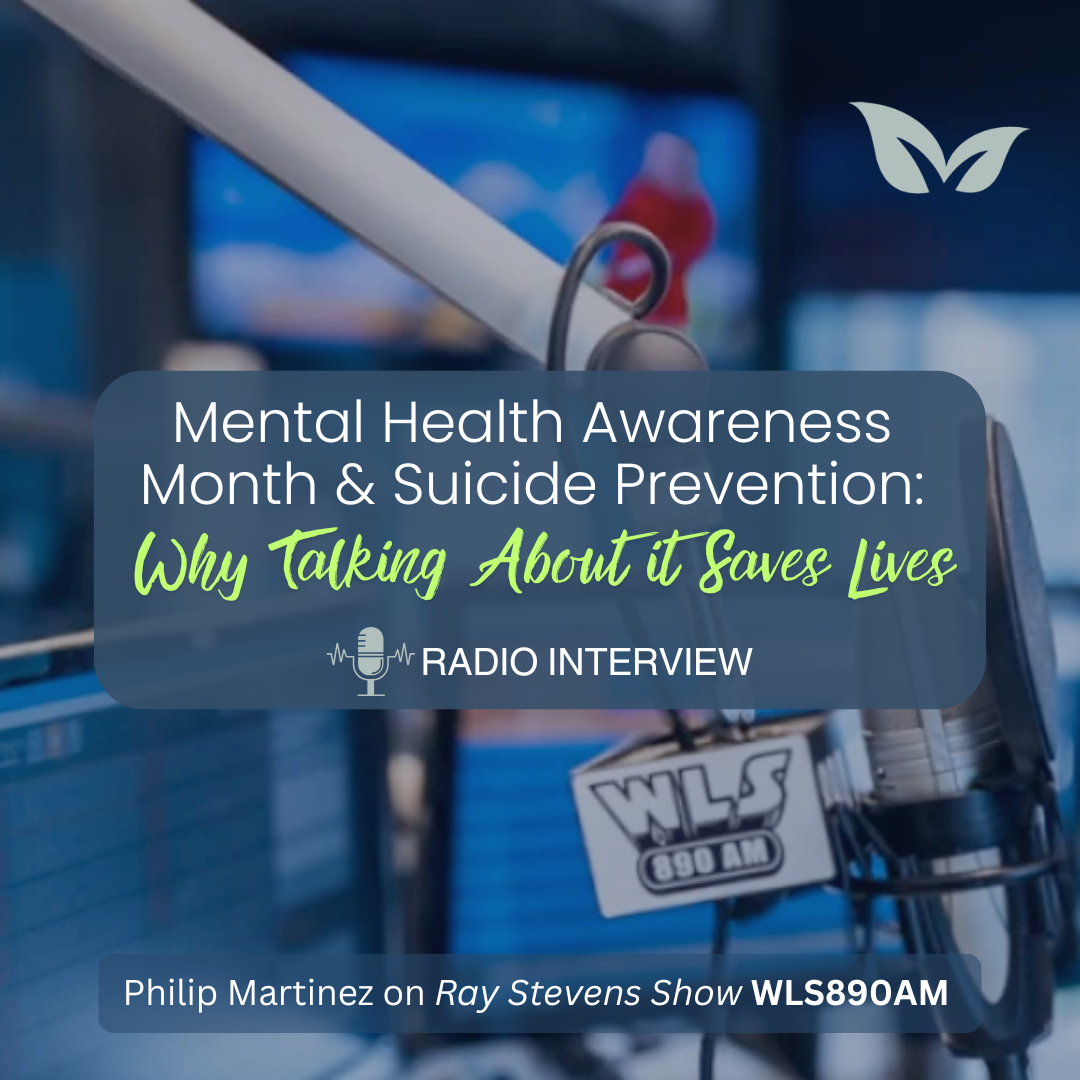
May is Mental Health Awareness Month, and this year one of our own at Grow Wellness Group took that message to one of the largest talk radio audiences in Chicago.
Philip Martinez, LCPC, therapist at Grow Wellness Group in Naperville, joined Ray Stevens on WLS890AM on Monday, May 4, 2026, to talk about mental health awareness and suicide prevention. It was the kind of conversation you don't hear often enough on mainstream radio. Direct, honest, and rooted in decades of real clinical experience.
You can listen to the full segment beginning at the 1:24:35 mark here: The Ray Stevens Show, Monday May 4, 2026: https://omny.fm/shows/ray-stevens-show/the-ray-stevens-show-monday-may-4th-2026?t=84m35s
We wanted to expand on that conversation here, sharing some of the context and heart behind what Philip brought to that microphone, and making sure these messages reach everyone who needs to hear them.
Philip is a Licensed Clinical Professional Counselor with 30 years of experience in the mental health field. He has worked across a wide range of clinical settings over those three decades, with a particular focus on teenagers, young adults, and the families who love and worry about them. He has a genuine gift for connecting with adolescents who have been through the system, seen multiple therapists, and showed up at his door convinced nothing was going to help. And more often than not, he helps them find that change actually is possible.
His specializations include anxiety and mood disorders, substance misuse and addiction, and the area he brings to this conversation with the deepest personal commitment: survivors of suicide and those affected by suicide loss.
What makes Philip's presence on the radio so meaningful isn't just his clinical background. It's the 20-plus years he has spent volunteering with the American Foundation for Suicide Prevention, quietly and consistently, without any fanfare, working to advance their mission of saving lives and bringing hope to people touched by suicide. He has shown up for that work long before it was a trending topic or a media moment. It's simply who he is.
We are proud that someone with Philip's depth of experience and humanity represents Grow Wellness Group in conversations like this one.
May is Mental Health Awareness Month, a time set aside each year to reduce stigma, open conversations, and remind people that help exists. At Grow, we take that seriously. Not as a marketing exercise, but as a real opportunity to meet people where they are, including people who might catch a radio segment on their morning commute and hear something they needed to hear.
This year feels especially important. Rates of anxiety and depression remain high, particularly among young people. Suicide is still one of the leading causes of death for Americans under 35. And despite real progress in public awareness, stigma persists. That quiet, persistent belief that struggling means weakness, that asking for help means failure. It still keeps millions of people from reaching out.
Philip has sat with that reality for 30 years. He knows what it looks like when someone waits too long. He also knows, with the kind of certainty that only comes from doing this work for decades, that intervention helps, that connection heals, and that one person saying "I see you and I'm here" can be the thing that saves a life.
One of the most important things a mental health professional can do in a public setting is replace fear with information. Suicide is a topic our culture has learned to whisper around, to speak of in vague terms, to treat as something unspeakable. That silence doesn't protect people. It isolates them.
Talking about suicide does not plant the idea. This is one of the most persistent and damaging myths out there. Research consistently shows that asking someone directly whether they are thinking about suicide does not increase risk. It can actually decrease it by opening a door and breaking isolation. If you are worried about someone, it is safer to ask than to stay silent.
Suicide is not a character flaw. It is most often the endpoint of a period of profound psychological pain, pain that has exceeded someone's available coping resources. Thinking about it that way, as a pain problem rather than a character problem, changes how we approach both prevention and healing.
Warning signs are real and learnable. Withdrawal from friends and family, giving away possessions, talking about being a burden, a sudden calm after a period of distress, increased substance use, expressing hopelessness about the future. These are signals that deserve a response. You don't have to be a clinician to act on them. You just have to be willing to reach toward someone.
When someone dies by suicide, the people left behind often carry a particular kind of grief, complicated by guilt, by unanswerable questions, and by a loss that our culture is often poorly equipped to hold. Phil's work with survivors of suicide loss reflects his belief that these individuals deserve the same compassionate, skilled support as anyone else navigating profound loss.
And help works. Crisis intervention works. Therapy works. Connection works. People who have experienced suicidal ideation and received support go on to live full, meaningful lives. Recovery is not a myth. It is what happens when someone reaches out, or when someone reaches toward them.
The American Foundation for Suicide Prevention is the nation's largest nonprofit dedicated to saving lives and bringing hope to those affected by suicide. Their work spans research, survivor support, advocacy, and public education programs like the Out of the Darkness community walks held across the country, including right here in the Chicago suburbs.
Philip has been a part of that work for over 20 years. That kind of sustained commitment doesn't come from professional obligation. It comes from someone who has looked at a wound in the world and decided to keep showing up to help heal it.
In fact, Philip currently serves as board chair for the AFSP Illinois chapter, and this summer and fall he has helped put together what might be the most meaningful stretch of events the chapter has seen in years. If any of the following resonate with you, we'd love to see you there.
On the morning of June 13, the Illinois Construction Hike for Hope takes place in two locations simultaneously: Downers Grove and Grafton in southern Illinois. This event is close to Philip's heart for a specific reason. The construction and extraction industry currently has the highest suicide rate of any profession in the country. This hike is about reaching into that community directly, breaking down stigma where it often runs deepest, and letting workers and their families know that support exists. If you work in construction, know someone who does, or simply want to show up for a community that doesn't always feel seen, this one is worth your morning. You can register at https://supporting.afsp.org/ILConstruction
That same weekend, June 13 and 14, brings something genuinely historic back to Chicago. The Out of the Darkness Overnight Walk is a 16-mile walk from dusk until dawn along Chicago's lakefront, beginning and ending at Navy Pier. It is the national flagship event of the AFSP, and it has not been held in Chicago since 2009. Bringing it back to Chicago has been a personal goal of Philip's since he became board chair, and this June it is finally happening. There is something powerful about walking through the night with hundreds of other people, all of you moving through the dark toward the light, for the same reason. If you can do one thing this summer for suicide prevention, this might be it. Learn more and register at https://www.theovernight.org/Chicago2026
And then in the fall, on October 3, the Chicago-land Out of the Darkness Walk returns to Montrose Harbor for a 3-mile walk along one of the most beautiful stretches of the lakefront. This is the chapter's mainstay local event, a community gathering that brings together survivors, advocates, families, and anyone who has ever been touched by suicide loss or mental health struggle. It is a shorter commitment than the Overnight but no less meaningful. You can find more information and sign up at https://afsp.chicagowalk.org/
We are proud to support these events and the work behind them. Whether you walk, volunteer, donate, or simply share the links with someone who might need to see them, it all matters.
If you are struggling right now, with anxiety, with depression, with grief, with a sense that things are darker than you can carry, you are not alone and you are not weak. The fact that you are still here, still getting through your days, is evidence of a strength that deserves recognition, not shame.
And if you are worried about someone in your life, if something feels off, if something they said is sitting in your chest, trust that feeling. Reach toward them. Ask the question. You won't make it worse. You might make all the difference.
Mental Health Awareness Month is not about one month. It's about building a world where the conversation Philip had on WLS 890AM doesn't feel brave or unusual. Where it's just what we do, all year, for each other.
988 Suicide & Crisis Lifeline — Call or text 988, available 24/7. Confidential support from trained counselors.
Crisis Text Line — Text HOME to 741741 to connect with a crisis counselor via text.
American Foundation for Suicide Prevention — https://afsp.org/chapter/illinois, with resources, survivor support, and Out of the Darkness walks near you.
NAMI Helpline — 1-800-950-NAMI (6264), the National Alliance on Mental Illness support line for mental health information and referrals.
If you or someone you love is struggling and looking for support, Grow Wellness Group would be honored to help. Contact us today at info@growwellnessgroup.com or 331-457-2020 to learn more about how we can walk alongside you.

