

Back-to-school season puts pressure on busy parents who need to balance schedules, emotional support, and academic expectations inside a few short weeks. Grow Wellness Group is a Naperville-based mental wellness practice whose child therapists work with families across DuPage County to ease the transition from summer freedom into structured school days. This guide covers practical back-to-school tips for busy parents - including how to build emotional regulation skills, set sustainable routines, manage peer influence and screen time, and recognize the signs that a child needs professional support. Each section pairs research-backed strategies with the real-world adjustments Naperville families use to keep the school year calmer and more connected.
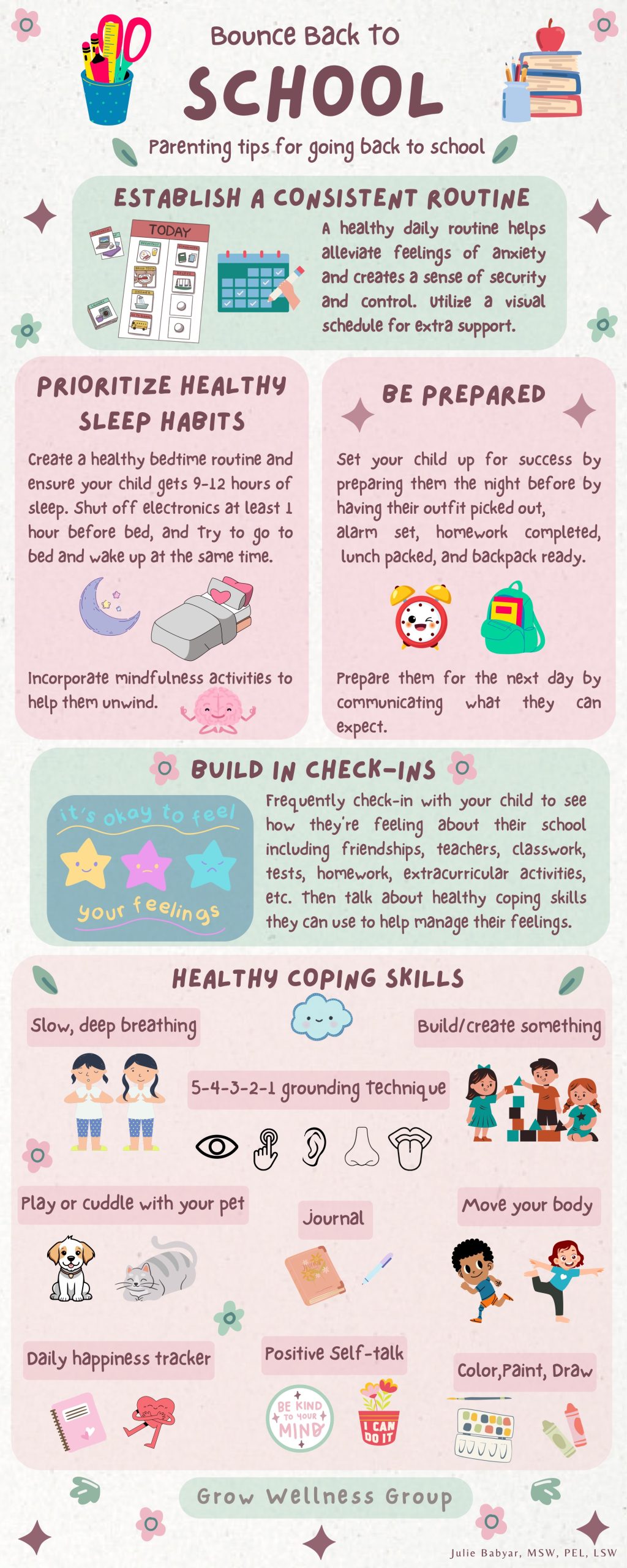
Key Takeaways: Back-to-school transitions disrupt kids' summer routines while adding academic, social, and sensory demands at the same time. Children process the back-to-school transition through their nervous systems before they can name what they feel, which often appears as irritability or stomachaches. Parents who treat the back-to-school transition as a real adjustment, not a switch to flip, reduce shame and open the door to support.
The back-to-school transition compresses three big shifts into a few weeks: a shorter and earlier sleep schedule, a return to sustained focus and academic load, and a re-entry into peer dynamics that have changed since June. For most children, the body registers these changes before the mind has language for them. A second-grader who was happy all summer may suddenly resist getting dressed in the morning. A middle-schooler who texted friends nonstop in July may go quiet the first week of August. These reactions are not behavior problems - they are the nervous system processing change.
Developmental guidance from the American Academy of Pediatrics notes that children's circadian rhythms naturally shift later during summer break, then have to be pulled forward by 1 to 3 hours when school resumes. Combined with new teachers, new classrooms, and new social hierarchies, the cognitive load adds up fast. Younger children may show the strain through clinginess, tears, or stomachaches. Older children and teens often show it through irritability, withdrawal, or sleep disruption.
Parents who name the back-to-school transition as a real adjustment - not a willpower issue - set the tone for the rest of the school year. Saying "this is a hard week for your body and your brain, and that's normal" gives a child permission to feel what they feel without shame. That single reframe often does more for the first two weeks of school than any other parenting move. The strategies in the following sections build on that foundation.
Key Takeaways: Parents help children build emotional regulation skills by labeling feelings out loud, modeling calm responses, and creating predictable check-ins after school each day. Emotional regulation in school-aged kids develops through co-regulation first - meaning a child borrows a parent's nervous system before building their own. Specific tools like four-square breathing, "name it to tame it," and a feelings chart give children language and a body-based response before reactions escalate.
Emotional regulation is the ability to notice a feeling, name it, and choose how to respond before reacting. For school-aged children, this skill develops through co-regulation first - meaning a parent's calm nervous system teaches the child's nervous system what calm feels like. A frustrated parent who matches a child's escalation locks both bodies into stress. A parent who slows down, lowers their voice, and breathes audibly gives the child a model to mirror.
Three tools work consistently with children ages 5 to 14. The first is "name it to tame it," a phrase popularized by Dr. Dan Siegel: labeling a feeling out loud — "you're frustrated because homework is harder than you thought" - calms the brain's threat response within seconds. The second is four-square breathing: inhale for four counts, hold for four, exhale for four, hold for four. Children can do this on the school bus, in a bathroom at school, or in the car before getting out. The third is a daily after-school check-in: ten minutes of undivided parent attention with no questions about homework, just connection. That reset shapes how the rest of the evening feels.
These practices build the foundation for self-awareness in children, which is the long-term goal of emotional regulation work. For parents who want structured guidance beyond at-home practice, Grow Wellness Group offers parenting education sessions that build these skills systematically. Families dealing with bigger behavioral patterns - meltdowns, school refusal, defiance - often benefit from working with a child therapist who can pair direct work with the child alongside parent coaching.
Key Takeaways: Effective back-to-school routines include consistent sleep windows, a predictable homework block, and at least one hour of unstructured downtime each weekday. Kids ages 6 to 12 need 9 to 12 hours of sleep nightly, and teens 13 to 18 need 8 to 10 hours, according to CDC guidance. Back-to-school routines work best when parents shift bedtimes gradually - 15 minutes every two days, starting about two weeks before school.
Routine is the single biggest lever parents have during the school year. A child who knows what comes next has fewer transitions to fight about, fewer surprises to brace for, and more energy left for school itself. The most effective back-to-school routines cover three blocks: a sleep window, a homework block, and dedicated downtime - in that order of importance.
Sleep is the foundation. The Centers for Disease Control and Prevention recommends 9 to 12 hours of sleep nightly for children ages 6 to 12, and 8 to 10 hours for teens ages 13 to 18. Most kids do not get this during the school year. Parents who shift bedtime gradually - 15 minutes earlier every two days, starting two weeks before school — avoid the painful first-week crash that comes from a hard reset. Screens out of the bedroom by 8 p.m. for elementary kids and 9:30 p.m. for teens consistently improves sleep quality more than any other change parents make.
The homework block works best when it is the same place, same time, every weekday. A kitchen table at 4:30 p.m. with a snack and water beats "wherever you can find" at "whenever you get to it." Younger children need 20 to 30 minutes; middle-schoolers 45 to 90; high-schoolers as the workload demands. Equally important is what comes after: at least one hour of unstructured downtime each weekday. The pressure to fill every after-school hour with activities is one of the most common causes of burnout in kids. Grow Wellness Group's child counseling team regularly helps Naperville families recalibrate these schedules when early signs of burnout appear.
Key Takeaways: Peer influence is the strongest behavioral force on children ages 9 to 14, and screen time amplifies that effect through group chats and short-form video. Common Sense Media reports that tweens average 5 hours 33 minutes of daily screen use, much of it inside social apps. Parents who keep phones out of bedrooms at night and ask specific questions about online interactions reduce risky peer dynamics.
Peer influence is the strongest behavioral force on children ages 9 to 14, and the school year intensifies it. A child who spent the summer with two or three friends now navigates a 25-person classroom, a lunchroom social ladder, group chats that run from 7 a.m. to midnight, and a feed of curated images from people they sit next to in math. Common Sense Media's research reports that tweens average 5 hours 33 minutes of screen use per day, much of it inside social apps where peer comparison directly shapes mood, sleep, and self-image.
Three parental moves consistently reduce harm without forcing a screens-or-nothing fight. The first is a physical phone-parking spot outside the bedroom by 8 p.m. - a hallway shelf, a kitchen drawer, anywhere out of the bedroom. Sleep alone improves dramatically. The second is one shared meal per day with phones off the table for everyone, including parents. That meal becomes the predictable place where actual conversations happen. The third is specific questions instead of "how was school?" - try "what's something funny that happened on the bus?" or "who did you sit with at lunch?" Specificity opens doors that "how was school?" closes.
Bullying - online or in person - needs a different response than ordinary peer friction. StopBullying.gov, the federal anti-bullying resource, distinguishes between conflict and bullying based on power imbalance and repetition. Parents who suspect bullying should document specifics, contact the school in writing, and consider teen counseling when the child shows anxiety, withdrawal, or sleep disruption. Therapy gives the child a place to process what happened that is separate from the parent or the school.
Key Takeaways: Signs a child needs professional support include changes lasting more than two weeks: school refusal, recurring physical complaints, withdrawal from friends, or sudden grade drops. Recurring stomachaches and headaches without a medical cause are common somatic signals of anxiety in school-aged kids and warrant a therapist's evaluation. A child needing professional support rarely says so directly - parents and teachers usually notice the pattern before the child can name what's wrong.
Some back-to-school stress is normal and resolves within two to three weeks. The signs that something more is happening usually share two features: they last longer than two weeks, and they appear in more than one area of life. A child who refuses school for one morning is having a hard day. A child who refuses school for three weeks while also losing interest in friends and complaining of stomachaches every morning is signaling something a therapist should evaluate.
The most common patterns child therapists see in the fall are school refusal, separation anxiety in elementary kids, social anxiety in middle-schoolers, and depression masked as irritability in teens. The National Institute of Mental Health reports that 7.1% of children ages 3 to 17 have a diagnosed anxiety disorder, and many more meet criteria but have never been evaluated. Physical signs - recurring headaches, stomachaches, fatigue, appetite changes - frequently precede the emotional admission. Pediatricians can rule out medical causes, but the next step is usually a child therapist rather than waiting for the symptom to escalate.
Parents sometimes hesitate to call because they worry about labeling their child or because therapy feels disproportionate. The opposite is more often true: early intervention shortens treatment. A 10-year-old whose school refusal is addressed in October typically returns to a regular schedule within six to eight weeks. The same situation left until December tends to require months of work and sometimes a treatment team. Grow Wellness Group's resources for parents and families cover how to recognize these patterns earlier and what to do first.
Key Takeaways: Parents looking for a child therapist should verify licensure (LCSW, LCPC, or licensed psychologist), specialty experience with the child's age range, and clear communication about treatment goals. The best child therapists explain their approach in plain language, involve parents in treatment planning, and set measurable goals within the first three sessions. A qualified child therapist should be comfortable coordinating with schools, pediatricians, and psychiatrists when a child's needs cross multiple care settings.
The differences between child therapists matter more than most parents realize. A good match shortens the work; a poor match wastes months. Three criteria separate a qualified child therapist from a generic provider: appropriate licensure, specialty experience with the child's specific age and presenting concern, and clear communication about how progress will be measured.
Licensure in Illinois for child therapy work includes LCSW (Licensed Clinical Social Worker), LCPC (Licensed Clinical Professional Counselor), and licensed psychologist. Each can provide effective therapy, but the right credential depends on what the child needs. Psychologists handle diagnostic assessment and complex cases; LCSWs and LCPCs deliver most ongoing therapy. Ask whether the therapist has worked with children in the same age band as your child and with the same primary concern - anxiety, ADHD, trauma, grief, or family transition.
Beyond credentials, parents should listen for plain-language explanations. A therapist who says "we'll work on coping skills using cognitive-behavioral therapy with weekly homework, and you'll see progress notes every four weeks" is easier to work with than one who speaks only in clinical terms. Ask how the therapist coordinates with schools, pediatricians, and psychiatrists when needed - fragmented care is one of the most common reasons therapy stalls. Many Grow Wellness Group child therapists routinely partner with Naperville School District 203 and Indian Prairie School District 204, write 504 and IEP support letters, and coordinate with psychiatrists when medication may help. Families navigating bigger transitions sometimes also benefit from family counseling alongside child-focused work.
Grow Wellness Group's child and adolescent team has supported Naperville families through more than a decade of back-to-school seasons. The practice is based at 200 East 5th Avenue in Naperville and works with families across DuPage County, Will County, and statewide via teletherapy. The team includes specialists across the developmental spectrum - from early childhood through young adulthood - and coordinates with local schools, pediatricians, and psychiatrists when a child's care benefits from a team approach.
Child and adolescent therapists at Grow Wellness Group who routinely work with school-aged concerns include:
The practice's approach aligns with SAMHSA family-centered care principles - meaning the child is the client, but parents, siblings, teachers, and pediatricians are partners in the work. Many families start with a single child therapy intake and add parenting sessions or family work as the picture develops over the school year.
Ready to make this school year calmer?
Grow Wellness Group's Naperville child therapists work with families across DuPage County in person and via teletherapy. Schedule a consultation to build a plan that fits your child and your schedule.


